By JOCELYN NOVECK AP National Writer
NEW YORK (AP) — You certainly don’t have to tell Beyoncé this: Fashion, when deployed properly, is nothing less than art.
Now, the fashion-forward superstar will have another chance to make the point. When she co-chairs the Met Gala in May, all eyeballs will be glued to the steps of the Metropolitan Museum of Art to see how one of the most watched women on the planet, in her eighth gala appearance, interprets the dress code: “Fashion is art.”
The museum announced the dress code Monday, along with some gala-related details including new guest names. Joining the top co-chairs — Beyoncé, Nicole Kidman,tennis champ Venus Williams and Vogue’s Anna Wintour — is a “host committee” chaired by designer Anthony Vaccarello and filmmaker Zoë Kravitz, and featuring names from Sabrina Carpenter and Teyana Taylor to Lena Dunham and Misty Copeland. Additions include actor Angela Bassett and athlete Aimee Mullins.
They, and everyone else attending, will be figuring out what to wear come May 4. The code seems to have been chosen for maximum flexibility. And, quips Andrew Bolton, curator of the Met’s Costume Institute: “Hopefully, it will put an end to the rather obsolete ‘Is Fashion Art?’ debate once and for all.”
Looking at ‘the dressed body’ through the centuries
For Bolton, though, the show’s the thing, to paraphrase Hamlet. As gala-watchers know, the big party is not only a fundraiser for the institute — a self-funding department — but a launchpad for the annual spring fashion exhibit. Curated by Bolton and his team, this year’s show, “Costume Art,” seeks to present fashion as a through-line in the entire history of art.
The exhibit will be the biggest, in terms of objects, that the institute’s ever done: nearly 400 in total, or 200 garments and 200 artworks from around the museum, placed in pairs. “It’s a beast,” Bolton said, looking a tad exhausted as he guided a reporter around the beginnings of the exhibit on a recent visit.
The idea, he noted, is to examine “the dressed body” in all its aspects, and to make the point that not only is fashion art — something previous shows have shown — but that art is fashion. “It’s reversing what we’ve done before,” Bolton says. “Now we’re looking at art through the lens of fashion.”
What that means, in practice, is that you might see an art object in a glass case — say, a vase from ancient Greece. Displayed above the case will be a garment from the museum’s vast costume collection, echoing the fashion on figures in that vase.
For now, walls full of Post-it notes
Right now, that vase is represented by a small color snapshot, affixed with dozens of others to the walls of a small conference room in the bowels of the museum — along with countless Post-it notes. Bolton has been spending lots of time in this space, which looks rather like a teenager’s room (albeit a very cultured teenager.)
Bolton walks along the walls, pointing out each of 12 sections organized to show the range of bodies — and body types — in art. Some are pervasive, like the classical body or the naked body.
Others have been overlooked, like the disabled body, the aging body, or the corpulent body. Bolton notes that in art, the corpulent body has almost entirely been used as a fertility symbol. “It’s like the notion that corpulence does not exist without fertility,” he says.
Then there’s the pregnant body, also much overlooked in both art and fashion history. It’s represented here by the pairing of Edgar Degas’ “Pregnant Woman,” a naturalist sculpture that gives a rare look at 19th-century maternity, with designer Georgina Godley’s 1986 dress featuring exaggerated padded curves — defined as “a radical feminist critique” of traditional fashion.
The exhibit, which seeks to emphasize diversity in body types, also aims to enable viewers to see themselves in some of the fashions. Thus, mannequins will feature heads with polished steel surfaces — as in mirrors – designed by artist Samar Hejazi.
A splashy new home for fashion at the Met
Bolton, who’s curated the Met’s biggest costume shows, nonetheless says he felt special pressure here to do “something spectacular.” That’s because “Costume Art” is inaugurating, with fanfare, a prominent new home for the museum’s fashion exhibits. The new Conde M. Nast Galleries — created from what was formerly the museum’s retail store — will occupy nearly 12,000 square feet (1,115 square meters) off the museum’s Great Hall.
For one thing, that will mean gala guests now can conveniently view the exhibit and then stroll easily to the dinner portion of the evening at the Temple of Dendur — or toggle between the two. A more lasting result: it will prevent snaking lines elsewhere in the museum, once the show opens to the public May 10.
For “Costume Art,” the galleries, still being completed, consist of two main rooms with different heights — one with an 18-foot ceiling, one with a 9-foot ceiling. The idea is for viewers to weave in and out of each space. “There’s a permeability,” Bolton says.
He calls the new show, already, one of the highlights of his career — and a statement of intent.
“We’re trying to make a statement here — that this is something WE can do at the Met,” he explains. “We have access to 16 curatorial departments across the museum.” And, of course, access to the institute’s more than 33,000 garments. “Really, nobody else has this capacity,” Bolton says.
He hopes the show will inaugurate not only new galleries, but an era of collaboration with the rest of the museum – one that puts fashion, well, forward.
“Costume Art” will run from May 10 through Jan. 10, 2027.
News
Met Gala guests (and the rest of us) learn the next dress code: ‘Fashion is Art’
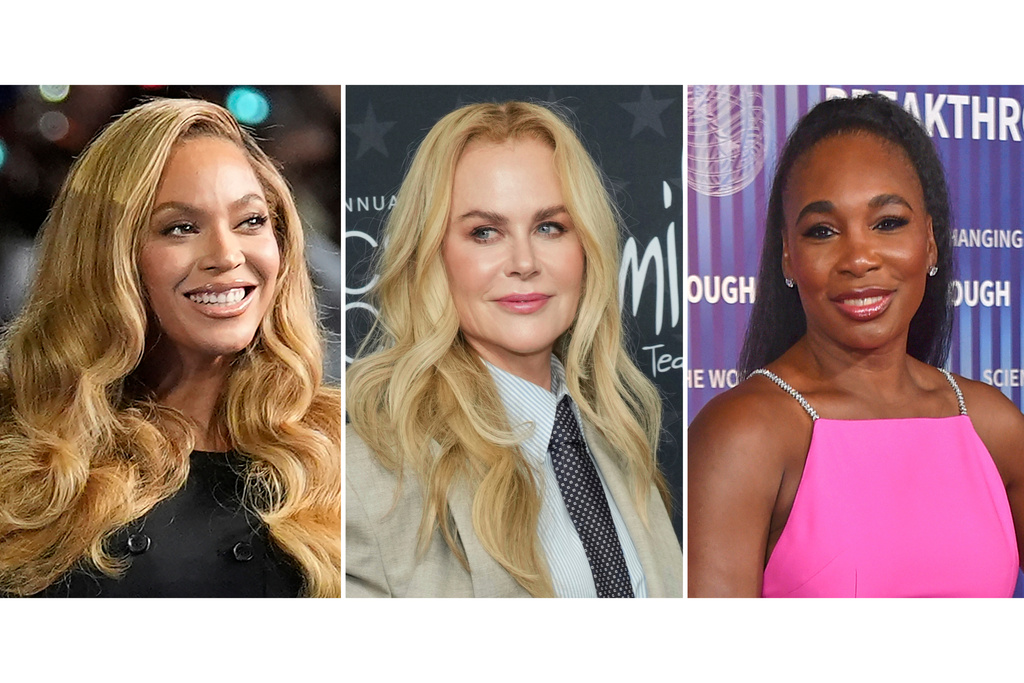
Beyonce appears at a campaign event in Houston, on Oct. 25, 2024, left, Nicole Kidman appears at the 30th Critics Choice Awards Santa Monica, Calif., on Feb. 7, 2025, center, and Venus Williams appears at the 10th Breakthrough Prize Ceremony in Los Angeles on April 13, 2024. (AP Photo) Photo: Associated Press